

How to Choose HDPE Plastic Pipe for Global Projects?
Choosing an hdpe plastic pipe for a global project requires more than comparing prices or wall thickness. The pipe must match pressure, temperature, soil movement, installation methods, and local standards. ISO 4427 covers polyethylene piping systems for water supply and pressure sewerage. AWWA C906-21 addresses polyethylene pressure pipe and fittings from four to sixty-five inches. ASTM F714 also defines outside-diameter-controlled polyethylene pipe requirements. These documents provide a practical technical foundation, but they do not replace project-specific engineering.
Market reports from Grand View Research and Fortune Business Insights identify infrastructure renewal, water security, and corrosion resistance as major drivers of HDPE pipe demand. Their forecasts show continued market expansion, although estimates differ by region and research method. That uncertainty matters. Global buyers should verify resin grades, PE classification, pressure ratings, fusion procedures, and factory quality records. Mike Folkman, P.E., a respected buried-pipe specialist associated with the Plastics Pipe Institute, offers a useful reminder: “The pipe is only one component of the system.” The trench matters. So does installation quality.
A reliable selection process should examine long-term hydrostatic strength, resistance to chemicals, ultraviolet exposure, thermal expansion, and expected surge pressure. Request independent test results, traceable resin documentation, and references from comparable projects. A visually smooth pipe can still fail through poor fusion or unsuitable bedding. That detail is easy to underestimate. Regional regulations, potable-water approvals, and shipping conditions also require careful review. The best hdpe plastic pipe is not automatically the thickest or cheapest option. It is the product that performs safely within the complete design system.
HDPE Pipe Fundamentals for International Infrastructure Projects
How to Choose HDPE Plastic Pipe for Global Projects?
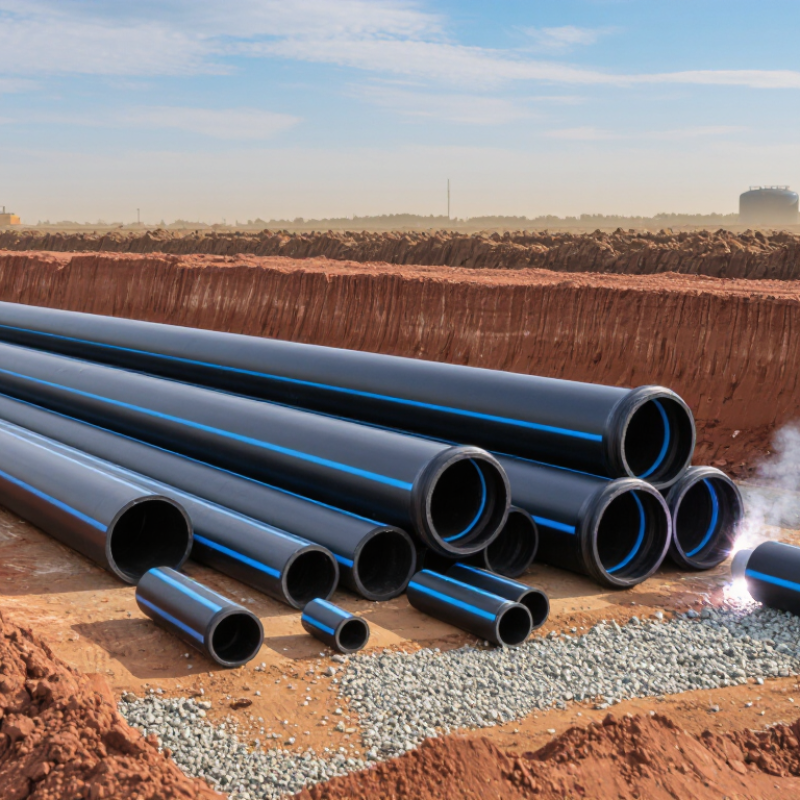
HDPE pipe fundamentals begin with the project environment. Global infrastructure may face rocky soil, coastal salt, freezing temperatures, or intense sunlight. HDPE handles movement well because it is flexible and corrosion resistant. However, flexibility does not replace proper design. Engineers should confirm pressure, temperature, fluid type, burial depth, and expected service life.
Pipe diameter and wall thickness must match the hydraulic model. The SDR rating affects pressure capacity, so it requires careful checking. Fusion joints also need trained operators, clean surfaces, controlled heating, and recorded parameters. On large sites, small installation errors can become expensive leaks. Quality plans should include material certificates, dimensional checks, joint inspection, and pressure testing. Local standards may differ. That detail is easy to overlook.
Tips: Compare project specifications with recognized international standards and local requirements. Request traceable test records. Inspect pipe storage areas for sharp objects and prolonged heat exposure. Allow thermal movement during layout planning. A perfect selection is rare. Recheck assumptions when field conditions change. Engineers should also review soil reports instead of relying only on typical design tables. That extra review can prevent a costly redesign.
| Project Requirement | Recommended HDPE Selection | Key Technical Data | International Project Considerations |
|---|---|---|---|
| Municipal potable-water transmission | PE100 pressure pipe, SDR17 or SDR11 | Nominal pressure: PN10 for SDR17; PN16 for SDR11 at 20°C water service | Confirm compliance with the project’s adopted standard, potable-water approval, hydrostatic test pressure, and local installation code. |
| Buried gravity sewer or drainage | PE100 or equivalent polyethylene pipe selected for ring stiffness and installation conditions | Common stiffness classes include SN2, SN4, SN8, and SN16; the required class depends on cover depth, traffic load, bedding, and groundwater. | For non-pressure service, stiffness and deflection criteria are usually more important than PN pressure class. |
| Long-distance water pipeline | PE100 with a larger outside diameter and SDR selected by design pressure | Typical advantages include low hydraulic roughness, corrosion resistance, and continuous fused joints. | Assess surge pressure, pump start/stop cycles, air valves, anchor points, thermal movement, and installation logistics. |
| Gas distribution | Gas-grade polyethylene pipe approved under the applicable gas standard | Pressure ratings and allowable operating pressures differ from water applications and must not be transferred directly. | Use only approved gas materials, qualified fusion procedures, tracer or locating requirements, and national gas-network regulations. |
| Industrial chemical or process service | Material and wall thickness selected from chemical compatibility and temperature data | Chemical resistance varies with concentration, temperature, exposure time, and stress level. | Obtain a compatibility review before specifying pipe for solvents, oxidizers, hydrocarbons, or elevated-temperature fluids. |
| Trenchless crossing or river installation | PE100 pipe with sufficient wall thickness for pulling, buoyancy control, and temporary stresses | Consider pullback force, allowable tensile stress, bend radius, external pressure, and minimum cover. | The installation design may require a lower SDR than the operating-pressure calculation alone would indicate. |
| Hot or high-temperature service | HDPE only where the temperature-adjusted design pressure is acceptable | Pressure capacity decreases as operating temperature rises; calculate using the applicable temperature derating factors. | For continuous service above approximately 60°C, another thermoplastic or metallic material may be more suitable. |
| Outside Diameter (mm) | SDR 17 Wall Thickness (mm) | SDR 17 Nominal Pressure | SDR 11 Wall Thickness (mm) | SDR 11 Nominal Pressure | Approximate Internal Diameter, SDR17 (mm) |
|---|---|---|---|---|---|
| 110 | 6.5 | PN10 | 10.0 | PN16 | 97.0 |
| 160 | 9.4 | PN10 | 14.6 | PN16 | 141.2 |
| 225 | 13.4 | PN10 | 20.5 | PN16 | 198.2 |
| 315 | 18.7 | PN10 | 28.6 | PN16 | 277.6 |
| 400 | 23.5 | PN10 | 36.4 | PN16 | 353.0 |
| 630 | 37.1 | PN10 | 57.3 | PN16 | 555.8 |
Related Posts
-
How to Choose the Right HDPE Plastic Pipe?
-
2026 Top Benefits of Using HDPE Plastic Pipe in Modern Construction
-

Exploring the Benefits of HDPE Pipe: Why Its Durability and Chemical Resistance Make It an Industry Standard
-
What is Poly Water Pipe? Benefits, Uses, and Installation Guide
-
Top 5 Essential Tips for Choosing the Best PE Fitting for Your Plumbing Needs
-

2026 Top Trends in Poly Water Pipe Innovations and Applications?