
Vinidex manufacturers and supplies a broad range of products & systems to suit a range of applications.
Vinidex’s products and systems are versatile and can be used in a variety of markets and applications.
China Top 10 Barite Radiation Shielding Suppliers introduces manufacturers serving hospitals, dental clinics, laboratories, and industrial imaging facilities. These companies may offer barite panels, radiation shielding boards, premixed compounds, and Barite Drywall Radiation Shielding systems. Their products can help create denser wall assemblies around X-ray rooms, CT suites, and diagnostic areas.
Radiation-shielding specialist Dr. Michael G. Stabin has emphasized a practical principle: “Shielding decisions must follow measured exposure, not assumptions.” That principle matters when comparing Chinese suppliers. Product density, barite purity, panel thickness, joint treatment, and installation quality all influence real performance. A product sheet is only a starting point. Independent test reports, factory quality procedures, batch records, and technical support deserve closer attention.
This ranking is not a final verdict. Supplier capabilities can change. Some websites provide limited information. Others present impressive images but few measurable details. Buyers should request current laboratory data, declared lead-equivalent performance, moisture resistance information, and clear delivery terms. They should also confirm whether testing reflects the intended wall structure, not only a small sample.
The physical details matter. A poorly sealed joint can leave a narrow but important weakness. Heavy panels may also require stronger framing and careful handling. Experienced suppliers should explain these risks clearly, without promising impossible protection levels. This guide therefore focuses on evidence, communication, manufacturing consistency, and practical project experience. It aims to support informed comparison, while recognizing that a qualified radiation-protection consultant must approve the final design.
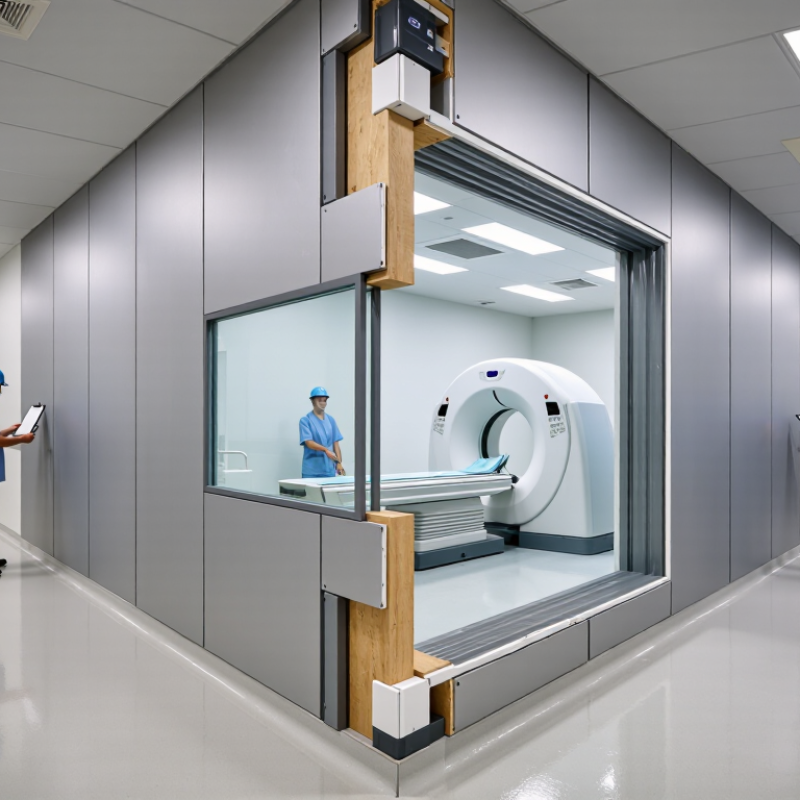
Barite radiation shielding is a building material system that uses barite, a dense barium sulfate mineral, to reduce penetrating radiation. Its high density increases the probability that X-rays or gamma rays will interact with the material. These interactions weaken radiation intensity through absorption and scattering. Barite concrete is commonly used around diagnostic imaging rooms, treatment areas, and laboratory walls.
The working principle is practical. A wall with enough mass creates a longer path for radiation. Barite aggregate can replace ordinary stone in concrete, raising the mixture’s density. Correct placement matters as much as the material itself. Gaps around doors, cable routes, and ventilation openings may create leakage paths. Shielding plans should therefore follow measured workload, beam direction, room geometry, and equipment energy.
Details matter.
In project work, technicians usually verify aggregate grading, moisture content, density, and surface quality. They may also inspect joints and penetrations after construction. Barite shielding does not eliminate radiation, and thicker walls are not automatically better. Poor mixing can cause uneven protection. Calculations should be reviewed by qualified radiation physicists and checked against local building requirements. Supplier claims deserve evidence, including test reports and traceable material data. I have found that site conditions often challenge the original design. A reliable assessment leaves room for measurement, correction, and honest uncertainty.
Barite radiation shielding materials serve demanding medical and industrial spaces. Their main use is in X-ray rooms, CT suites, radiotherapy areas, and nuclear medicine departments. Barite aggregate can produce concrete with densities around 3.3–3.7 g/cm³, compared with approximately 2.3 g/cm³ for ordinary concrete. This higher density helps reduce wall thickness where space is limited.
The IAEA Safety Reports Series No. 47 states that shielding design must consider workload, distance, occupancy, and radiation direction. Barite concrete therefore suits walls, floors, ceilings, and equipment barriers with uneven exposure patterns. In diagnostic imaging rooms, it is often combined with lead glass, steel doors, and controlled access layouts. Industrial users also apply it around inspection laboratories and radiation-source storage areas. The material is useful, but not automatically sufficient.
NCRP Report No. 147 emphasizes project-specific calculations rather than fixed shielding thickness. Field surveys should verify installed performance after construction. Suppliers should provide density records, mix proportions, compressive-strength data, and independent radiation-transmission tests. A 2023 review in Radiation Physics and Chemistry reported that barite concrete performance depends strongly on aggregate grading, moisture, and workmanship. This is easy to overlook. Small voids can weaken protection. Selection should follow the approved shielding plan and local regulations, not only a supplier’s brochure.
China Top 10 Barite Radiation Shielding Suppliers
Key Criteria for Evaluating Chinese Barite Suppliers
Barite’s shielding performance depends on density, chemical purity, thickness, and installation quality. A low-priced powder may fail if its density varies between batches. According to the USGS Mineral Commodity Summaries 2024, global barite mine production was approximately 9 million metric tons in 2023. This scale shows strong supply capacity, but not automatic quality consistency.
Ask suppliers for recent test reports covering BaSO4 content, specific gravity, moisture, particle size, and harmful trace elements. For radiation shielding, request density results from an ISO/IEC 17025-accredited laboratory. Compare those results with attenuation data from the NIST XCOM database and project-specific calculations. The IAEA also emphasizes verified material properties and controlled construction details in shielding design guidance.
Numbers can mislead. A supplier may provide one excellent sample while shipping a mixed-grade batch later. I would inspect batch codes, sealed packaging, loading records, and retention samples. Check whether the factory controls crushing, screening, drying, and blending internally. Ask for a small trial batch before approving a large order. Test the powder. One weakness remains: public factory information is often incomplete, especially for trace-element control. Independent retesting is therefore sensible, even when documents look professional. Suppliers should also explain storage conditions, because moisture can change handling behavior and final mix accuracy.
| Evaluation Item | Key Criterion | Recommended Evidence | Suggested Weight | Verification Status |
|---|---|---|---|---|
| 01 | Barite purity and barium sulfate content | Recent third-party laboratory report using XRF or equivalent chemical analysis; batch-specific COA preferred. | 20% | Must be verified |
| 02 | Bulk density and particle density | Laboratory density results, test method, moisture condition, and sampling procedure stated clearly. | 15% | Must be verified |
| 03 | Particle-size distribution | Sieve analysis or laser particle-size report matched to the required shielding-concrete or mortar formulation. | 10% | Must be verified |
| 04 | Moisture, clay, and soluble impurity control | Moisture analysis, insoluble-residue data, clay-content test, and contamination-control procedure. | 10% | Must be verified |
| 05 | Radiation-shielding performance support | Project-specific attenuation or shielding-concrete test data; results should identify radiation type, energy range, thickness, and density. | 15% | Must be verified |
| 06 | Quality-management system | Valid quality certificate, documented inspection plan, traceability procedure, and corrective-action records. | 8% | Certificate check required |
| 07 | Production and processing capability | Documented crushing, grinding, screening, drying, blending, and foreign-material removal capacity. | 7% | Site or document audit |
| 08 | Packaging and export logistics | Packaging specification, container-loading photos, moisture protection, port options, and Incoterms quotation. | 5% | Must be verified |
| 09 | Supply stability and minimum order quantity | Confirmed monthly capacity, lead time, minimum order quantity, safety-stock policy, and production allocation. | 5% | Commercial check required |
| 10 | Technical service and documentation | English technical data sheet, SDS, COA format, sample policy, response time, and complaint-resolution process. | 5% | Document review required |
| Total evaluation weight | 100% | Prequalification framework | ||
Note: Radiation-shielding performance depends on the complete mix design, material density, radiation type, photon or neutron energy, and installed thickness. Supplier claims should be confirmed with batch samples and independent testing before purchase.
China’s top ten barite radiation shielding suppliers should be assessed through verified material performance, not production volume alone. The USGS Mineral Commodity Summaries 2024 estimated global barite mine production at about 9.5 million metric tons in 2023. China remained one of the leading producers, supporting a broad domestic supply base for shielding concrete and specialist aggregates.
Barite aggregate commonly reaches about 4.1–4.5 g/cm³, according to technical references used in radiation shielding concrete design. Higher density can reduce the required wall thickness, but grading, moisture, and placement quality also affect shielding results. ASTM C637 provides relevant guidance for radiation-shielding concrete aggregates. Suppliers should provide particle-size data, chemical analysis, bulk density, and batch traceability.
Reliable suppliers also understand project conditions. Hospital imaging rooms, industrial inspection areas, and research facilities do not share identical energy ranges or construction limits. The IAEA emphasizes shielding calculations based on source energy, workload, occupancy, and distance. Suppliers offering only a generic lead-equivalent value are not enough.
Site experience reveals practical problems. Fine dust, uneven aggregate distribution, and rushed curing can weaken performance. I would question any catalogue that promises universal protection. Independent laboratory testing remains essential, although test results may not perfectly represent field installation. That gap deserves attention.
China’s top barite radiation shielding suppliers should be assessed through evidence, not ranking claims. The USGS Mineral Commodity Summaries 2024 estimated global barite mine production at roughly 8 million metric tons in 2023, with China among the leading producers. However, mining scale does not prove shielding performance. Buyers should request BaSO4 assay results, bulk density, particle-size distribution, moisture content, and batch traceability. Small differences matter when aggregate is mixed into dense concrete or shielding mortar.
Ask for ISO 9001 quality records and independent laboratory reports. ISO 14001 and ISO 45001 can indicate broader operational controls, but they do not certify radiation attenuation. ASTM C637 covers aggregates for radiation-shielding concrete, while ASTM C638 provides related terminology. These references help purchasing teams compare test methods. NIST photon cross-section data can support attenuation calculations, although laboratory validation remains necessary. Do not rely on density alone.
Inspect a retained sample physically. Good material should arrive in sealed bags or protected bulk packaging, with consistent color, limited dust, and no visible clay contamination. Confirm whether testing uses the actual energy range required by the project. A supplier may provide excellent chemical data but weak documentation for finished shielding performance. That gap deserves attention. I would also check delivery consistency, replacement procedures, and technical support before signing a long-term contract. Certifications look reassuring, yet independent testing is still the stronger safeguard.