Why is the Caesium Clock Important for Timekeeping?
The Caesium Clock represents a remarkable advancement in timekeeping technology. This atomic clock is based on the vibrations of Caesium atoms. Each second is defined by 9,192,631,770 oscillations of these atoms. It offers an unprecedented level of accuracy, which is crucial for modern science and technology.
The importance of the Caesium Clock extends beyond precise time measurement. It plays a vital role in GPS systems, telecommunications, and even satellite navigation. The synchronization provided by this clock ensures these systems function smoothly and accurately. However, relying on such technology brings its challenges. Are we perhaps too dependent on these precise measurements?
In our fast-paced world, the Caesium Clock is a cornerstone of timekeeping. It provides stability in an era where every second counts. Yet, we must reflect on our relationship with time. As our reliance on these clocks grows, it raises questions about the nature of time itself and our understanding of it. The Caesium Clock pushes the boundaries of what we know, but it also invites contemplation about accuracy and reliability.
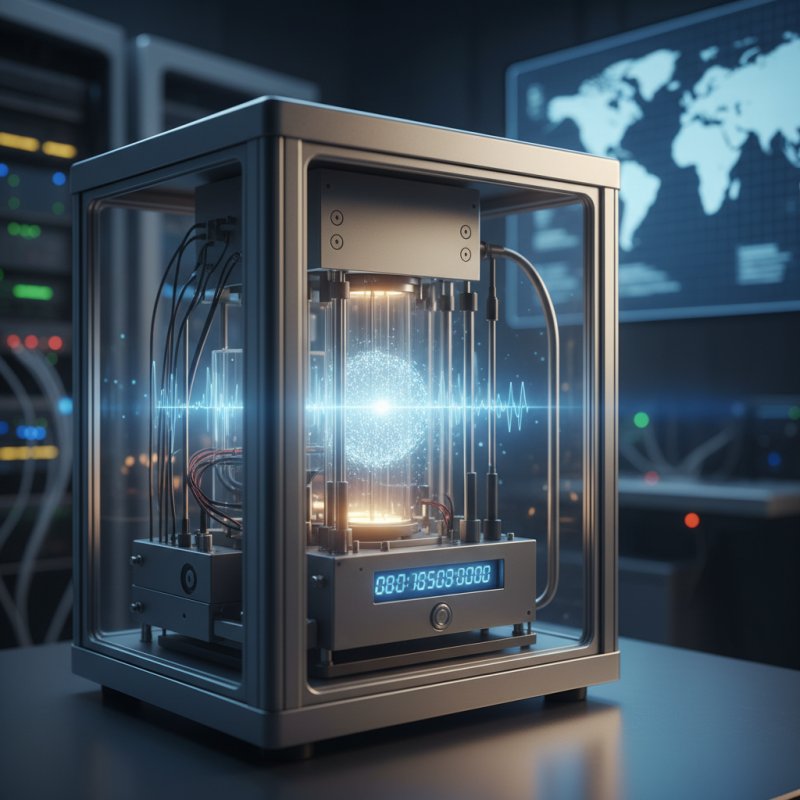
The Historical Development of Atomic Clocks and Their Significance
The journey of atomic clocks began in the mid-20th century. Early timekeeping methods relied on mechanical clocks. They were precise, but not perfect. The need for better accuracy led to the development of atomic clocks, particularly the cesium clock.
Cesium clocks use the vibrations of cesium atoms to measure time. They are incredibly accurate, capable of keeping time to within a billionth of a second. This precision has transformed fields like global positioning systems and telecommunications. However, as we depend on these technologies, we must also reflect on the fragility of such accuracy.
Despite advancements, cesium clocks face limitations. They require careful calibration and stable conditions. Any slight environmental change can impact measurements. The quest for perfect timekeeping continues. Scientists explore new materials and methods. They seek to create even more reliable clocks. What lies ahead in timekeeping may redefine our understanding of time itself.
Fundamental Principles of Caesium Clocks in Time Measurement
Caesium clocks are vital for precise timekeeping. They rely on the natural vibrations of caesium atoms. When these atoms transition between energy levels, they emit electromagnetic waves. This frequency remains constant, offering a reliable standard for measuring time.
The core principle of caesium clocks is based on atomic resonance. The clock measures the oscillations of caesium atoms to define the second. One second is defined as 9,192,631,770 cycles of the microwave radiation emitted by caesium. Even minor variances can lead to significant time discrepancies over long periods. It’s fascinating yet challenging to maintain this precision.
While caesium clocks have revolutionized time measurement, they are not without flaws. Environmental factors, like temperature and magnetic fields, can disrupt their accuracy. Regular calibration becomes essential, yet it is not always foolproof. Reflecting on these challenges shows the ongoing quest for even more precise timekeeping methods.
Accuracy and Precision: How Caesium Clocks Define the Second
The caesium clock is a cornerstone of modern timekeeping. It sets the standard for what we define as a second. This definition emerged from the properties of caesium atoms. The atoms vibrate at a specific frequency when energized. This measurement is incredibly stable, making it a reliable reference for time measurement.
Accuracy and precision are critical in science and technology. A caesium clock measures time to within a few billionths of a second. It gives us a reliable foundation for GPS, telecommunications, and scientific research. This precision is vital for synchronization across the globe. When you send a message or navigate using GPS, the timing is essential.
Tip: If you're curious about timekeeping, explore atomic clocks at local science museums.
Despite their accuracy, caesium clocks can have flaws. Environmental factors can affect their performance. Small variations in temperature or pressure may introduce inaccuracies. Scientists are continually refining these technologies to improve reliability.
Tip: Consider delving into how different clocks measure time. Understanding these variations can be eye-opening.
The caesium clock illustrates how science continuously challenges our grasp of time. Each advancement leads to new questions. It’s a reminder that even in precision, there are gaps worth exploring.
Applications of Caesium Clocks in Global Navigation and Telecommunications
Caesium clocks play a crucial role in global navigation and telecommunications. These precision timekeepers are essential for GPS systems, which guide millions of users daily. A report from the U.S. National Institute of Standards and Technology states that GPS relies on satellites synchronized to atomic time. This ensures pinpoint accuracy to within a few meters.
In telecommunications, cesium clocks help maintain synchronization within networks. A misalignment of just a few nanoseconds can result in data loss or corruption. Research shows that this precision is vital as the global telecommunications industry expects to reach a market size of over $2 trillion by 2024. Yet, despite the impressive capabilities of cesium clocks, they have limitations. They can drift slightly over very long periods, which can affect system accuracy and reliability.
Consider the growing demand for ultra-precise timing in emerging technologies, such as quantum computing. While cesium clocks are currently the standard, scientists continue to explore alternatives. Some advocate for optical lattice clocks. These propose higher accuracy and stability. The race for better timekeeping is not just about technology; it drives the need for reliability in navigation and communication systems around the world.
Emerging Technologies and the Future of Timekeeping Beyond Caesium Clocks
The caesium clock has significantly advanced our understanding of timekeeping. However, emerging technologies show promise for future improvements. Quantum technologies are at the forefront of this transformation. Researchers are exploring optical lattices and ion traps. These methods could outperform caesium clocks in precision. For example, optical lattice clocks use lasers to capture atoms. They offer better stability and accuracy.
New advancements also include atomic ensembles. This innovative technique enhances timekeeping through collective behavior of atoms. These clocks operate on a different frequency scale. Yet, they still rely on fundamental principles of quantum mechanics. It raises intriguing questions about our current measurements. Are we ready to embrace a new standard of time?
Additionally, there may be practical challenges. Implementing these technologies can be costly and complex. Many facilities may lack the resources for these advanced systems. Accessibility may hinder widespread adoption. As researchers push boundaries, society must consider the implications. How will this shift impact global synchronization? Timekeeping is more than just technology; it shapes our daily lives.
Evolution of Timekeeping Technologies
This bar chart illustrates the evolution of timekeeping technologies and their respective accuracy. From ancient sundials to modern optical lattice clocks, advancements in technology have drastically improved timekeeping precision. The caesium clock revolutionized time measurement, paving the way for the most accurate clocks used today.