How to Choose Marine Generator Sets for Your Vessel?
Choosing Marine Generator Sets for a vessel is a practical engineering decision, not a simple equipment purchase. The right set must match the vessel’s electrical load, operating profile, fuel strategy, and available machinery space. A fishing boat may need steady power for refrigeration and winches. A ferry may require quiet, reliable electricity for passengers and safety systems. An offshore vessel may demand strong performance during long periods away from port.
Begin with a measured load assessment. Record normal, peak, starting, and emergency loads separately. A large motor can create a sharp starting surge, even when its running demand appears modest. Check voltage, frequency, phase configuration, fuel consumption, cooling arrangements, and exhaust routing. A compact engine may fit the room, but maintenance access could become frustrating. Leave space for filters, belts, inspection, and safe component removal.
Marine conditions are unforgiving. Salt air, vibration, humidity, and changing loads can expose weak designs quickly. Review the manufacturer’s service history, spare-parts network, warranty terms, and documented test results. Confirm that the generator complies with applicable flag-state, class, and emission requirements. Independent verification matters. A polished brochure is not enough.
Redundancy also deserves careful thought. Two smaller sets may provide better flexibility than one large unit, but they can increase installation and maintenance demands. The first calculation is rarely perfect. Recheck assumptions with the chief engineer, naval architect, and vessel operator. Their experience often reveals details that a spreadsheet misses, such as night-time hotel loads, cold-start behavior, or limited fuel storage. Reliable selection comes from evidence, realistic operating data, and honest review.
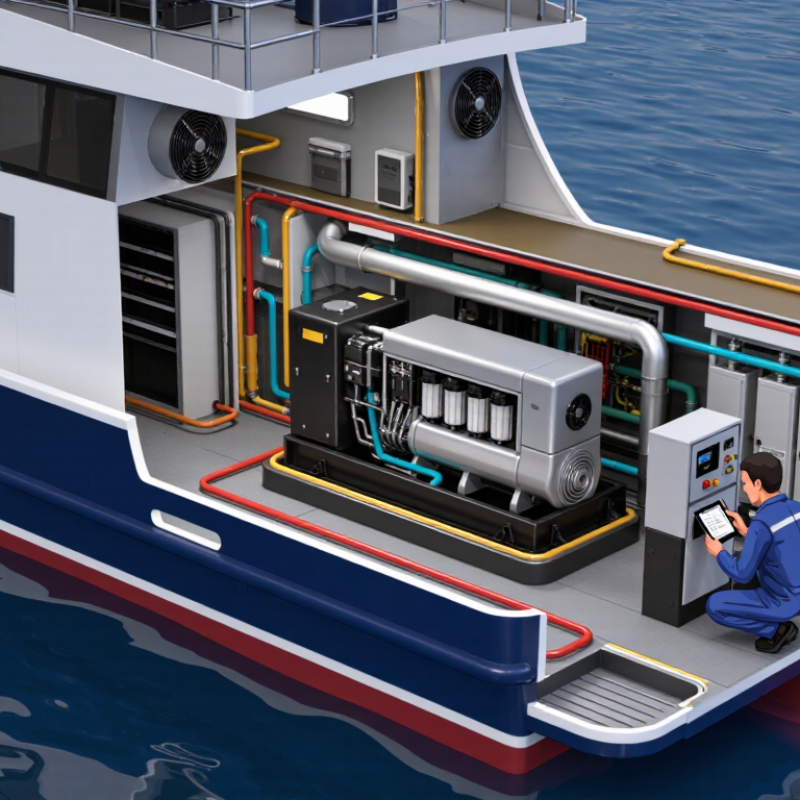
Define the Vessel’s Electrical Power Requirements
A marine generator set should match the vessel’s real electrical demand, not an optimistic estimate. Start with a complete load schedule for navigation, communication, pumps, lighting, HVAC, galley equipment, and emergency systems. Record each load’s rated power, operating hours, voltage, and starting current. Large motors may briefly demand several times their running current.
Separate continuous loads from intermittent loads. A seawater pump may run for hours, while a winch operates only during specific tasks. Note the worst operating condition, such as night navigation with HVAC, refrigeration, and cargo equipment running together. Include battery chargers and power losses. Small omissions can become expensive surprises.
Allow practical capacity for future equipment, but avoid excessive oversizing. An oversized generator can operate inefficiently at light loads, causing carbon buildup and poor fuel economy. Calculate demand using realistic diversity factors, then verify the result with measurements from a similar voyage or a temporary power logger. A clean spreadsheet is not proof. Crew habits often differ from design assumptions.
Check motor-starting performance, voltage stability, and frequency response before selecting the final rating. Consider whether one generator can support essential services after another unit is unavailable. Classification requirements and flag-state rules should be reviewed with a qualified marine engineer or surveyor. Sea trials may reveal load peaks that calculations miss. Keep those findings in the design record.
Compare Marine Generator Types and Fuel Options
Choosing a marine generator set starts with the vessel’s real operating profile, not its brochure rating. A diesel generator remains practical for frequent port calls, heavy auxiliary loads, and limited fuel infrastructure. It offers strong power density and familiar maintenance routines. The IMO Fourth GHG Study 2020 estimated shipping produced 2.89% of global anthropogenic greenhouse-gas emissions in 2018. Fuel efficiency now matters as much as rated output.
Gas and dual-fuel generators can reduce sulfur oxides and particulate emissions. However, LNG requires cryogenic storage, added safety systems, and careful methane-slip control. Methanol is easier to handle than LNG, but its lower energy density demands larger tanks. The DNV Maritime Forecast to 2050 identifies fuel availability and onboard storage as continuing barriers to wider alternative-fuel adoption.
Battery-hybrid systems suit ferries, harbor vessels, and short peak-load periods. They may not support long ocean passages alone. Not yet.
Fuel choice should match duty cycle, route, and local supply. The IEA’s World Energy Outlook 2023 shows continuing uncertainty in energy prices and infrastructure investment. That uncertainty can change lifecycle costs quickly. I would compare fuel consumption at 25%, 50%, and 75% load, rather than using one laboratory figure. Check transient response, service access, tank volume, emissions rules, and backup requirements. A smaller generator operating near its efficient load can outperform a larger unit running lightly. This is often overlooked. A perfectly clean option may not exist, but a well-matched system can reduce waste, maintenance pressure, and operational risk.
Evaluate Generator Size, Load Capacity, and Operating Efficiency
Choosing a marine generator set starts with the vessel’s real electrical demand, not its maximum equipment list. Record continuous loads, intermittent loads, and motor-starting surges separately. Pumps, compressors, winches, navigation systems, and refrigeration can create sharp demand changes. Add a practical reserve, but avoid excessive oversizing. A lightly loaded generator may run inefficiently, consume more fuel, and suffer from carbon buildup. A larger set feels safer. That assumption can mislead.
Evaluate load capacity across typical voyages, harbor operations, and emergency conditions. Review the load profile with a qualified marine electrician and compare it with the vessel’s electrical drawings. Confirm voltage, frequency, phase requirements, starting current, and parallel-operation needs. A load bank test can reveal weaknesses that calculations miss. Do not treat a single sea trial as complete proof. Weather, cargo, and crew routines may change demand.
Tips: Choose a generator that handles normal loads efficiently, while covering verified starting peaks. Measure actual fuel use at different load levels. Keep records after installation. Check alarms, cooling flow, exhaust temperature, and vibration during inspections. Follow applicable flag-state, classification, and maintenance requirements. Reassess the sizing after adding equipment. The best selection is not always the most powerful one; it is the one that remains stable, efficient, and serviceable during ordinary work.
How to Choose Marine Generator Sets for Your Vessel? - Evaluate Generator Size, Load Capacity, and Operating Efficiency
Typical planning ranges for marine generator selection. Final sizing should be verified against the vessel's electrical load study, classification requirements, ambient conditions, and installation limits. | Vessel Operating Profile | Typical Generator Rating | Recommended Continuous Load | Estimated Peak Load | Typical Fuel Consumption | Expected Electrical Efficiency | Key Selection Considerations |
| Small workboat or patrol vessel | 30–80 kW | 18–55 kW | 60–70 kW | 210–250 g/kWh | 82–88% | Allow for navigation electronics, pumps, communications equipment, lighting, and short-duration starting loads. |
| Coastal fishing vessel | 80–200 kW | 50–140 kW | 150–180 kW | 205–240 g/kWh | 84–90% | Check refrigeration, ice-making, hydraulic systems, winches, fish-processing equipment, and motor-starting requirements. |
| Passenger ferry or charter vessel | 150–500 kW | 100–350 kW | 300–450 kW | 200–235 g/kWh | 85–91% | Evaluate hotel loads, HVAC, galley equipment, passenger elevators, lighting, and redundancy for scheduled service. |
| Offshore support vessel | 400–1,200 kW | 280–850 kW | 750–1,050 kW | 195–230 g/kWh | 86–92% | Consider dynamic-positioning loads, thrusters, deck machinery, variable-speed drives, and N+1 generator redundancy. |
| Cargo or multipurpose vessel | 500–2,000 kW | 350–1,400 kW | 1,200–1,800 kW | 195–225 g/kWh | 87–92% | Review cargo pumps, cranes, ventilation, ballast systems, reefer containers, bow thrusters, and port-operation loads. |
| Large commercial or cruise vessel | 1,000–5,000+ kW | 700–3,500+ kW | 3,000–4,500+ kW | 190–220 g/kWh | 88–93% | Use multiple synchronized sets to improve redundancy, maintenance flexibility, part-load performance, and operational continuity. |
| Selection guideline: Size the generator for the calculated maximum demand plus a practical operating margin, while avoiding prolonged operation below approximately 30% load. Confirm transient response, motor-starting capacity, voltage and frequency regulation, fuel quality, cooling-water temperature, altitude, exhaust back pressure, noise limits, and applicable marine class or flag-state requirements. |
Check Installation Space, Safety Standards, and Environmental Conditions
How to Choose Marine Generator Sets for Your Vessel?
Choosing a marine generator set starts with the vessel, not the catalogue. Measure the available room, including service clearance, access doors, and lifting paths. A unit may fit on paper but remain impossible to remove. Leave space around filters, belts, terminals, and control panels. Check deck strength and the generator’s weight distribution. Keep the center of gravity low when possible. This reduces vibration and supports safer operation in rough seas.
Safety requirements must match the vessel’s flag state, classification rules, and applicable maritime conventions. Confirm emergency shutdown access, fuel isolation, exhaust routing, fire protection, grounding, and electrical insulation. Ventilation needs careful calculation. Insufficient airflow can raise engine-room temperatures and reduce output. Exhaust components also need proper insulation and safe clearance from combustible materials. Use certified marine-rated equipment and have qualified professionals review the installation drawings. Small oversights matter.
Environmental conditions can change the selection completely. Salt air demands corrosion-resistant materials and protected electrical connections. High humidity can damage insulation over time. Vibration, engine-room heat, and limited fresh-air supply require suitable mounting and cooling systems. Consider cold starts, tropical temperatures, and possible operation at altitude. I would not rely on average weather data alone. Local sea conditions may be harsher. A neat installation is not automatically a reliable one. Recheck noise, fumes, maintenance access, and drainage before commissioning.
Assess Maintenance Needs, Reliability, and Lifecycle Costs
How to Choose Marine Generator Sets for Your Vessel?
Select a generator for the vessel’s real duty cycle, not its brochure rating. Record average load, peak demand, start frequency, seawater temperature, and low-load operating hours. A unit running near 20% load may suffer from cylinder glazing and exhaust fouling. Small details matter. During onboard assessments, engineers should inspect filter access, service clearance, vibration points, and alarm visibility. These features reduce maintenance time when the vessel is rolling in poor weather.
The 2024 Safety and Shipping Review recorded 2,951 shipping incidents in 2023 and identified machinery damage among the leading causes. This supports a practical priority: choose clear diagnostics, accessible spare parts, and dependable failure response. The U.S. Department of Energy’s Operations and Maintenance Best Practices Guide also links condition-based maintenance with lower avoidable maintenance costs. However, sensors do not replace experienced inspections. They can drift. Lifecycle costing should include fuel at realistic loads, lubricants, overhauls, technician travel, downtime, and disposal. The IMO 2023 GHG Strategy targets a 20% emissions reduction by 2030, striving for 30%, compared with 2008 levels. Efficient part-load operation therefore affects future compliance exposure and operating costs. My first estimate would still be conservative. Fuel prices, port delays, and crew capability can change the result. The cheapest bid can age badly.
How to Choose Marine Generator Sets for Your Vessel?
Assessing service intervals helps compare maintenance workload, operational reliability, and lifecycle cost before selecting a marine generator set.
The chart shows common planning intervals for medium-speed and high-speed marine diesel generator maintenance. Actual schedules depend on engine design, load profile, fuel quality, operating environment, and the equipment manufacturer’s maintenance manual. Longer intervals can reduce downtime, but only when supported by oil analysis, condition monitoring, adequate spare parts, and qualified service personnel.