
Vinidex manufacturers and supplies a broad range of products & systems to suit a range of applications.
Vinidex’s products and systems are versatile and can be used in a variety of markets and applications.
China’s potato-chip sector depends on more than a fryer and a seasoning drum. A well-matched Potato Chips Production Line must control washing, peeling, slicing, frying, seasoning, and packing. Each stage affects texture, oil use, and product consistency. Buyers also need to consider local service, spare parts, and the supplier’s ability to test the line with their chosen potato varieties.
FAOSTAT reported global potato production of roughly 374 million tonnes in 2022. That figure shows the crop’s scale, but it does not guarantee uniform raw materials. Moisture, sugar levels, and slice thickness can change from batch to batch. Fortune Business Insights estimated the global potato chips market at about US$35.5 billion in 2023, reflecting a large market for processors and equipment makers. These reports provide useful context; they do not independently verify any supplier’s performance.
A dependable comparison should look beyond brochure capacity. Ask for a trial run, inspect the finished chips, and confirm what the quoted output includes. Small details matter. A slow seasoning feeder or an undersized cooling conveyor can disrupt an otherwise impressive line. FAO Director-General Qu Dongyu has emphasized the potato’s contribution to food security; that broad perspective is relevant, though it is not a technical endorsement of any equipment supplier. No verifiable, named production-line expert quotation was supplied, so a direct quote is not invented here.
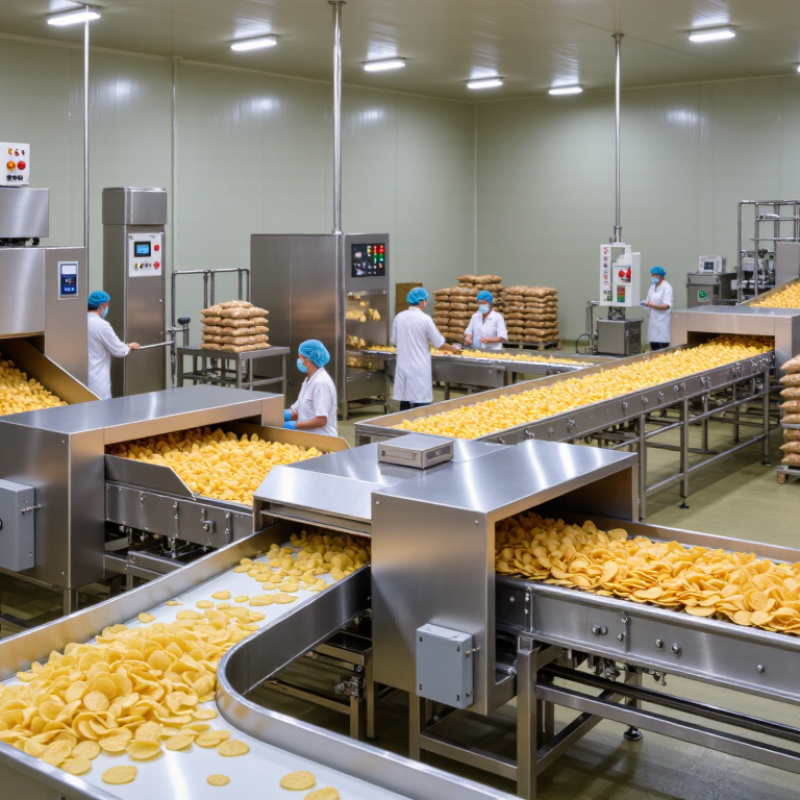
Assessing China’s top ten potato chips production line suppliers requires evidence, not polished brochures. Ask each supplier for rated capacity and stable output under similar potato varieties, slice thickness, and operating hours. A line advertised at high throughput may perform differently with wet slices or frequent product changes. Request recent installation references and discuss actual shift output with the operators, where possible. Small details matter.
Check that certificates are current and cover the factory and equipment being offered. Ask for certificate numbers, issuing bodies, and scope; a logo on a brochure is not enough. Then map the line scope in writing: washing, peeling, slicing, frying, seasoning, conveying, and packing. Confirm which items are included, such as oil filtration, control cabinets, and installation support. Ask how acceptance tests measure output, oil temperature stability, and product consistency. One spreadsheet rarely tells the whole story. A factory visit or live test can reveal cleaning access, weld quality, and whether operators can reach service points safely. Suppliers may describe capacity differently, so compare like with like—and record unanswered questions rather than assuming they are minor.
A dependable potato-chip production line starts with potatoes of similar size and condition. Slicers should produce even pieces, since uneven thickness can leave some chips pale and others overly crisp. Keep thickness consistent. Small details matter.
Freshly cut slices are washed to remove loose surface starch, which can help limit clumping and uneven browning. Water flow should be strong enough to clean the slices without damaging their edges. Washing alone does not guarantee a crisp result. Drain and dry the slices well before they reach the fryer; excess water can affect oil temperature and frying performance.
Frying commonly takes place between 160°C and 190°C, with the right setting depending on slice thickness, moisture, and line speed. Color changes quickly. Operators should monitor oil temperature and product appearance throughout the run, rather than relying on a fixed setting. For buyers comparing suppliers, ask how the line controls slicing thickness, wash-water flow, drying, and temperature. These practical details are easy to overlook, and even a well-designed line still needs careful adjustment for each potato batch.
When comparing China’s top potato chips production line suppliers, look beyond the headline capacity. Small lines may process roughly 100–200 kg of raw potatoes per hour, while larger systems can exceed 1,000 kg. These figures are not directly comparable. Some suppliers report raw-potato input; others report finished-chip output. Ask which figure appears on the quotation, and request a trial using potatoes similar to yours. Potato variety, slice thickness, and oil temperature all affect the result. Numbers can look neat on paper.
For chips targeting moisture below 2%, ask how the supplier measures the finished product. A calibrated moisture analyzer and a clearly stated sampling method make test results more useful. Frying time, slice uniformity, de-oiling, and cooling conditions can shift the reading. Packaging matters too: chips may absorb moisture if bags are sealed poorly or stored in humid air. Request trial samples from different points in a production run, not just one perfect batch. A low reading is encouraging, but it does not prove every shift will match. I would also check whether the line maintains even color and crispness at its quoted capacity. That detail is easy to overlook.
A practical review of China’s ten supplier profiles should compare complete lines, not just fryer capacity. Look for potato washing and peeling units, slicers, blanchers, continuous fryers, oil filters, seasoning drums, and packaging equipment. FAOSTAT’s 2022 crop data records roughly 375 million tonnes of potatoes worldwide, underscoring the scale of raw-material handling. Yet crop volume alone says little about chip quality. Slice thickness, frying temperature, oil circulation, and moisture control shape texture and yield. Ask suppliers for test-run records using your potato variety. Small details matter.
Automation claims deserve close inspection. Check whether line controls track temperature, belt speed, oil level, and alarms, and whether operators can retrieve production records. Service profiles should state response times, commissioning support, training, and spare-parts availability. Export reach is stronger when supported by documented installations and local technicians, not a destination list. UN Comtrade can help examine machinery trade flows, although broad product codes may not isolate potato-chip lines. Brochures can mislead. Request layout drawings, utility requirements, and references for similar capacities. One awkward truth: a highly automated line may still lose hours if cleaning access or changeovers are poorly designed.
Before comparing China’s potato chips production line suppliers, request a trial using potatoes similar to your planned raw material. Agree on the target output, slice thickness, and acceptable breakage before the test. Record the line speed and saleable yield, not just the machine’s maximum capacity. Watch the whole run. A short, staged demonstration proves little. Ask to inspect slices after washing, frying, seasoning, and cooling, then review the results against your written targets.
Energy figures need context. Ask for electricity and fuel use per kilogram of finished chips, measured across a sustained run. Confirm which equipment is included, such as fryers, exhaust systems, and conveyors. For food safety, inspect cleanable surfaces, oil filtration, guards, and access for sanitation. Request operating and cleaning procedures, not only equipment specifications. After-sales support deserves the same scrutiny: clarify technician response times, installation scope, training, and spare-parts availability. Get these commitments in writing. A polished proposal can still leave gaps; buyers sometimes overlook who pays for travel or delays. Check those details before placing an order.
Use these ten checks to compare potato chips production line offers. The rows are buyer-evaluation criteria, not a supplier ranking or claims about specific manufacturers. Confirm requirements against your product, site, destination market, and applicable regulations.
| No. | Evaluation dimension | What to verify | Evidence to request | Buyer check |
|---|---|---|---|---|
| 1 | Product and process fit | Confirm the proposed process suits the intended chip type, such as fresh-potato chips or formed chips, and covers the required stages from preparation through seasoning and packaging. | Process flow diagram, equipment list, product specification, and a written description of included and excluded scope. | Match each process step and product requirement to a named machine, operating condition, or clearly stated customer responsibility. |
| 2 | Line trial and product quality | Run a trial using the intended raw material, recipe, cut, and operating conditions. Assess finished-product characteristics and repeatability. | Trial protocol and results covering agreed product attributes, such as slice dimensions, color, texture, moisture, oil content, and seasoning distribution where relevant. | Agree in advance on the test product, sampling method, measurement method, pass criteria, and responsibility for trial materials. |
| 3 | Capacity and yield | Clarify whether quoted capacity refers to raw potatoes, prepared slices, finished chips, or packaged product. Account for product losses and operating conditions. | Capacity calculation, stated product and feed assumptions, operating-speed range, and trial or reference data for comparable products. | Compare offers using the same measurement point, product specification, operating hours, and definition of saleable output. |
| 4 | Energy and utility consumption | Review electricity, fuel or thermal energy, water, compressed air, and exhaust requirements. Consumption depends on line configuration, product, throughput, and operating conditions. | Utility schedule and estimated or measured consumption with units, measurement boundary, product, throughput, and test conditions stated. | Request comparable figures—for example, energy per kilogram of finished product—and verify what equipment and auxiliary systems are included. |
| 5 | Food safety and hygienic design | Check product-contact materials, cleanability, drainage, access for inspection, and measures to prevent contamination. Verify food-safety documentation relevant to the supplied equipment and facility. | Material declarations, product-contact surface information, cleaning instructions, risk assessment, and any current certificates with their scope and issuing body. | Assess the actual equipment and certificate scope. A certificate alone does not establish that every food-safety or regulatory requirement is met. |
| 6 | Cleaning and changeover | Understand how the equipment is cleaned, how parts are removed or accessed, and how product or seasoning changes affect cleaning time and line availability. | Cleaning procedure, recommended tools and agents, changeover steps, and details of parts requiring routine removal or inspection. | Review the procedure with the plant’s sanitation team and confirm it is compatible with site rules and the intended production schedule. |
| 7 | Controls, guarding, and site integration | Check control-system functions, emergency stops, machine guarding, electrical requirements, interfaces, and the intended division of installation responsibilities. | Electrical drawings, control-system description, equipment layout, interface list, and applicable conformity or safety documentation for the destination market. | Have qualified personnel review the design against local requirements and confirm utility connections, floor space, access, and upstream/downstream interfaces. |
| 8 | Installation and commissioning | Clarify what support is provided for installation, start-up, operator training, and performance verification, including travel and site-readiness requirements. | Installation plan, commissioning checklist, training agenda, site-preparation list, and written responsibility matrix. | Confirm milestones, required customer resources, acceptance tests, and how unresolved commissioning issues will be recorded and addressed. |
| 9 | After-sales service and spare parts | Establish service channels, technical support hours, escalation process, warranty terms, and availability of critical wear and replacement parts. | Written warranty, service contacts and response commitments, recommended spare-parts list, and parts ordering and shipping process. | Check that service commitments are documented and workable for the buyer’s location, time zone, language, and operating schedule. |
| 10 | Commercial scope and references | Compare the complete scope, exclusions, payment and delivery terms, documentation, and relevant operating references without relying on unsupported performance claims. | Itemized quotation, delivery schedule, contract scope, technical deviations list, and references for comparable equipment or applications where available. | Resolve differences between quotations in writing and verify references directly where possible, focusing on similar products, capacity, and operating conditions. |
Tip: Record each supplier’s answers and supporting documents against the same checklist. Treat unverified figures as estimates until confirmed through an agreed trial, contract specification, or documented acceptance test.