
Vinidex manufacturers and supplies a broad range of products & systems to suit a range of applications.
Vinidex’s products and systems are versatile and can be used in a variety of markets and applications.
Choosing a wheel lathe is not just a capacity decision. It affects finish quality, workshop flow, and the amount of material removed from each rim. A Diamond Cut Alloy Wheel Machine must handle real jobs: scuffed edges, varied wheel diameters, tight deadlines, and repeatable cuts. Small details matter.
Demand for repair also has a wider context. S&P Global Mobility reported that the average age of vehicles in the United States reached 12.6 years in 2024, extending a long-running upward trend. Older vehicles can mean more maintenance opportunities, though that figure alone does not prove demand for diamond-cut refinishing. Todd Campau, associate director of aftermarket solutions at S&P Global Mobility, said: “The continued growth in the average age of vehicles is a testament to the quality of vehicles being produced today and the willingness of consumers to maintain their vehicles for longer periods of time.” This is useful context, not a machine-selection rule.
Buyers still need to inspect the evidence. Compare supported wheel sizes, spindle accuracy, software, guarding, training, and service response. Ask suppliers to demonstrate a complete cut on a damaged sample wheel, then check the finish under direct light. The brochure is not enough. A polished surface can hide practical limits, and advertised speed may not match a busy workshop’s daily routine. The seven machines below are assessed through buyer-focused criteria, with trade-offs made visible. No model is perfect; the right choice depends on workload, operator skill, and after-sales support.
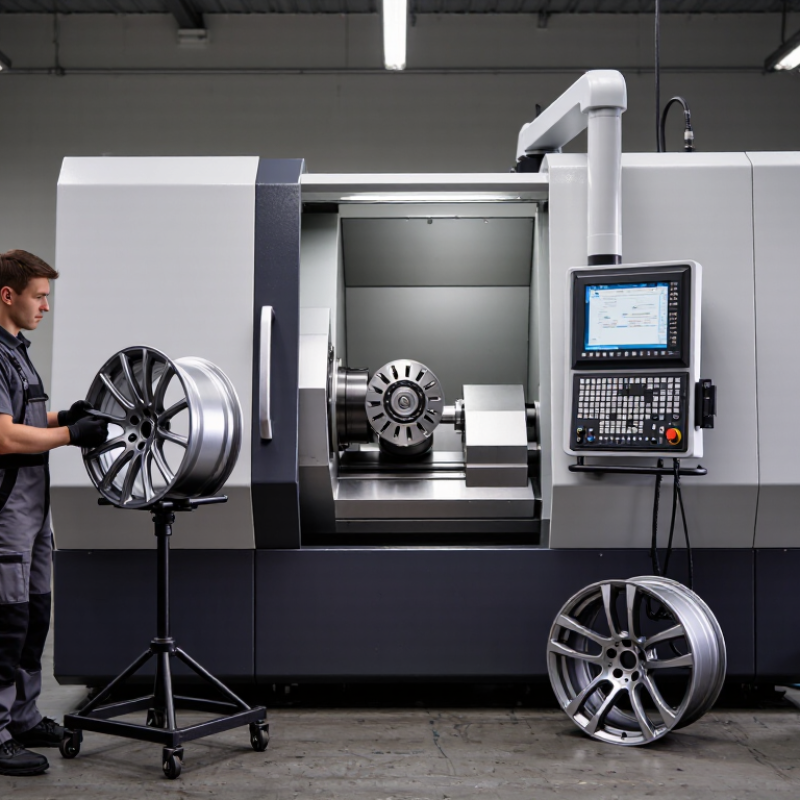
A diamond-cut alloy wheel machine restores a bright, machined face by removing a very thin layer of metal. The wheel is secured on a spindle, then a cutting tool follows its profile to recreate the fine lines across the surface. A probe or digital measurement helps map the wheel’s shape before cutting. Small details matter. Incorrect clamping can cause vibration, while excessive cutting may weaken the wheel or erase its original contours. The machine improves appearance, but it cannot repair every crack or structural defect.
The case for careful refurbishment is growing as vehicles stay on the road longer. S&P Global Mobility reported that the average age of light vehicles in the United States reached 12.6 years in 2024. Older vehicles can mean more demand for practical repairs, though this figure does not measure wheel-repair demand directly. After machining, technicians typically inspect the face, remove burrs, and apply a clear protective coating. That finish needs time to cure. It is not magic. A deep gouge may remain visible, and some wheels should be rejected rather than cut again. In practice, the best result depends on accurate measurement, conservative material removal, and an honest assessment of the wheel’s condition.
A diamond-cut alloy wheel machine depends on more than a sharp tool. Its core components usually include a rigid frame, precision spindle, wheel fixture, CNC controller, and single-point diamond tool. A probe or measuring system helps map the wheel face before cutting. Stability matters: even slight vibration can leave fine lines across a bright surface. Small details matter.
The operator inspects the wheel for cracks, bends, and previous cuts, then mounts it securely and checks its runout. The machine scans the face and builds a surface profile. Based on that profile, the controller guides a shallow pass across the machined areas. Cutting depth must stay controlled, since removing too much material can weaken the wheel or limit future refinishing. Coolant and chip management also help keep the tool path clean.
In practice, setup is rarely as tidy as a brochure suggests. Curved spokes and earlier repairs can complicate scanning, so the operator may need to review the program before cutting. After machining, the wheel is checked for finish consistency and dimensional issues. Not every wheel is a good candidate. For buyers comparing machines, look closely at spindle accuracy, fixture adjustment, scan reliability, and how clearly the system reports its measurements.
Diamond-cut alloy wheel machines generally fall into three groups: manual lathes, semi-automatic systems, and CNC lathes. Manual machines offer direct control, but results depend heavily on operator skill. Semi-automatic models can simplify setup and repeat common cuts. CNC machines use programmed paths and, on some models, a probe to map the wheel face before cutting. That mapping helps avoid removing more material than needed.
Check the working range, not just the machine’s headline capacity. Confirm maximum wheel diameter, width, and weight against the wheels you expect to service. Spindle stability, clamping options, and cutting-tool compatibility also affect finish quality. A clear control interface and accessible guarding matter during daily use. Small details matter. Ask how the machine handles curved spokes, damaged faces, and repeat jobs; a smooth demonstration on one wheel proves little.
Software, measurement systems, and service support can separate otherwise similar machines. Ask whether programs can be adjusted for different wheel profiles, and how operators verify cutting depth. A machine with fast setup may still need careful manual correction. Not always. Buyers should compare the full workflow, including loading, measurement, cutting, and inspection, rather than focusing only on advertised speed. A modest learning curve is normal, but unclear setup instructions can become an expensive frustration.
| Machine Type | Best Suited For | Typical Wheel Capacity | Cutting and Operating Configuration | Key Capabilities | Important Buyer Checks |
|---|---|---|---|---|---|
| Entry-Level Semi-Automatic CNC Lathe | Small repair shops handling occasional diamond-cut wheel work | Commonly configured for passenger-car wheels in the approximate 12–24 in range; capacity depends on the machine’s swing and fixture | Operator sets the cutting path or parameters; CNC controls the programmed tool movement | Lower-cost entry to repeatable resurfacing; suitable for relatively straightforward face designs | Check supported wheel diameter and width, setup time, guarding, training, and whether scanning or programming is included |
| General-Purpose CNC Diamond-Cut Lathe | Independent wheel-refurbishment shops with regular passenger-car jobs | Many configurations accommodate approximately 12–30 in wheels; confirm maximum wheel width and weight separately | CNC-controlled cutting tool follows a programmed path while the wheel is securely mounted and rotated | Versatile option for common flat-face and machined-face wheel profiles; balances capability and floor-space needs | Review spindle and fixture specifications, tool access, software workflow, service support, and the exact usable work envelope |
| Multi-Axis CNC Wheel Lathe | Shops handling varied spoke shapes and more complex wheel-face geometry | Capacity varies by model; passenger-wheel configurations commonly cover a broad range up to around 30 in | Additional controlled axes allow more flexible tool positioning and cutting-path movement | Can accommodate a wider variety of profiles than a basic setup when supported by suitable programming and tooling | Ask which axes are simultaneously controlled, what shapes can be cut, and whether the software supports the intended wheel designs |
| Scan-Guided CNC Lathe | Shops seeking to reduce manual profile measurement and programming work | Determined by the lathe’s work envelope; scanning capability does not increase the machine’s maximum wheel size | A probe or optical scanner captures wheel-face geometry; software uses the scan to help create a cutting path | Can help reproduce an existing face profile and simplify setup for unfamiliar designs | Check scanner type, scan coverage, software compatibility, operator review steps, and performance on damaged or reflective surfaces |
| Portable or Compact Wheel Lathe | Mobile repair services or workshops with limited floor space | Usually designed around a more restricted wheel-size and weight range; verify the actual limits before purchase | Compact mounting and clamping arrangement; some systems are designed to work close to the vehicle or in a mobile setup | Can reduce transport of wheels to a separate machine when the system and job are suitable | Check mounting method, stability, power requirements, safe operating clearances, and which repairs can be performed on-site |
| Combined Lathe and Milling System | Refurbishers who need both face cutting and additional machining operations | Varies by configuration; confirm capacity for each operation, not just the stated maximum wheel diameter | Combines a lathe-style cutting setup with a milling capability or interchangeable machining arrangement | Can support a broader range of repair and finishing tasks than a single-purpose lathe | Compare changeover time, available tooling, guarding, software functions, and whether both operations meet the shop’s quality requirements |
| Automated or Production-Cell CNC System | High-throughput refurbishment operations with consistent job volume | Defined by the cell’s lathe, loading equipment, and wheel-handling fixtures; confirm the full system envelope | CNC cutting may be integrated with automated loading, measurement, or material handling | Can reduce repetitive handling and support more consistent production workflows when jobs are standardized | Evaluate throughput under real job conditions, operator supervision, cell footprint, safety interlocks, integration, and maintenance needs |
| Specification note: Capacity figures above are indicative ranges for common passenger-wheel equipment, not guaranteed specifications. Actual limits depend on the machine, clamping system, tooling, wheel design, and operating procedure. Confirm the manufacturer’s rated wheel diameter, width, weight, electrical requirements, and safety documentation before purchase. | |||||
Seven notable diamond-cut alloy wheel machines suit different workshop needs: compact CNC lathes for limited floor space, single-axis lathes for routine refinishing, multi-axis systems for varied profiles, and mobile units for on-site work. Buyers may also compare machines with integrated scanning, manual-assisted controls, or higher-capacity clamping. These are useful categories, not guarantees of performance. A polished brochure cannot show how a machine behaves with a bent rim or a stubborn coating.
Check the details that shape daily results: scanner repeatability, cutting depth control, cycle time, guarding, training, and service access. Ask for a live demonstration using a wheel similar to those your shop handles. Watch the first pass closely. Too much material removal can shorten a wheel’s usable life, while an inaccurate scan may leave visible lines near the spoke edges. The U.S. Bureau of Labor Statistics projects 4% employment growth for automotive service technicians and mechanics from 2023 to 2033, with about 67,700 openings each year; its Occupational Outlook Handbook offers useful workforce context, though it does not measure wheel-repair demand. The right setup still depends on local workload, operator skill, and repair standards. That part is easy to underestimate.
Comparing seven diamond cut alloy wheel machines starts with the work your workshop actually handles. Record common wheel diameters, face profiles, and daily job volume before reviewing specifications. A machine that suits occasional repairs may slow a shop processing several wheels each day. Fit matters.
Check the clamping range and spindle accuracy, then ask how the machine scans wheel faces and controls each cut. A clear interface can reduce setup errors, but it cannot compensate for poor fixturing. Ask for a demonstration using a wheel similar to those you service. Watch the setup, cutting pass, and finish under good lighting. Small ripples or uneven machining lines are easier to spot on a real sample than in a brochure.
Also compare extraction, guarding, floor space, and access to routine service. Fine metal dust needs proper collection, and operators should be able to reach controls without awkward stretching. Noise matters. Request details about training, maintenance intervals, and replacement parts before judging price alone. A cheaper machine may carry a higher cost if downtime is frequent. I would still leave room for doubt: stated cycle times rarely reflect every wheel’s condition or repair history. Check practical support and test results, not just headline specifications.